Feels throw back ish today, you’ll get the gist.
I’m knee-deep in a data and analytics migration for a wealth management firm right now, and something keeps happening in nearly every working session.
Someone pulls up a data model, a schema map, a list of source systems, and starts talking about the migration like it’s a plumbing job. Move the pipes. Map the fields. Validate the ETL. Get the dashboards to look the same on the other side.
And technically, they’re right. That is the job.
But it’s not the job that matters.
The question that actually determines whether this migration changes anything for the firm isn’t “did we move the data correctly.” It’s “which handful of business questions, if we could finally answer them well, would change how this entire firm performs.” That’s a completely different conversation. It requires understanding the business — the advisors, the compliance pressure, the client relationships, the actual decisions people are trying to make at 7am before markets open — not just the tables.
I’ve started calling this the gist problem. Everyone on a project can tell you the mechanics. Almost nobody can tell you the gist. And the gist is the only part that was ever going to be valuable.
Over-Used, Under-Used, Misused
Co-wrote a piece recently with Scott Snyder for Knowledge at Wharton on whether AI is killing UX. Scott’s spent decades inside digital transformation at a scale most of us will never touch, and the argument we landed on together applies well past UX. It applies to basically any decision-making process that runs on data, research, or insight.
Here’s the shape of it. Understanding gets shallow in three ways:
Over-used. You’ve got the dashboard, the persona deck, the journey map, the fifty-slide research readout. You’ve got so much material that everyone in the room feels informed. Feeling informed and being informed are not the same thing, and the gap between them is where bad decisions hide. More artifacts create the appearance of rigor. They don’t create rigor.
Under-used. The research exists. Somebody did the interviews, ran the analysis, wrote the report. Then it sits in a shared drive nobody opens again, because the actual decision got made in a hallway conversation the week before the readout was even scheduled. The insight was available. It just wasn’t in the room when it mattered.
Misused. This is the sneaky one. Real data, real research, applied to answer the wrong question, or stretched to justify a decision that was already made. You see this constantly with AI-generated personas and synthetic research right now — the output looks rigorous, cites patterns, has confidence intervals. It’s still make-believe if nobody talked to an actual human being who lives the problem.
All three produce the same failure mode: a team that feels certain and is wrong.
Deep Research Beats Well-Worded Prompts
Every one of us right now has access to tools that can generate a plausible-sounding answer to almost anything in less than four seconds. That is genuinely useful. It is also the most dangerous thing happening in decision-making today, because plausible and true have never been further apart in how easy they are to produce.
On the wealth management project, the fastest path would be to let a model summarize the source systems, propose a target schema, and generate migration logic. And that’s a fine starting point for the mechanics. But the migration only pays off if we’ve actually done the unglamorous work of sitting with the business — understanding what advisors need to see the moment a client calls upset about a statement, understanding which compliance questions actually get escalated versus which ones just generate paperwork, understanding where the firm’s real bottlenecks live versus where people assume they live.
That’s not a prompting problem. You cannot prompt your way into context you never went and got. Deep research and real business understanding will beat a well-worded prompt every single time, because a prompt only knows what you already told it. The gist lives outside the model, in the people and the pressure and the history that never made it into any document.
The Arc of Uncertainty Is Where the Gist Lives
In my book I write about something I call the arc of uncertainty — that stretch between confidently thinking you understand a problem and actually, uncomfortably, learning what it really is. Most teams try to skip straight from “confident ignorance” to “we have an answer,” because the middle of that arc feels bad. Nobody enjoys the stretch where your first model of the problem turns out to be wrong and you don’t yet have a better one.
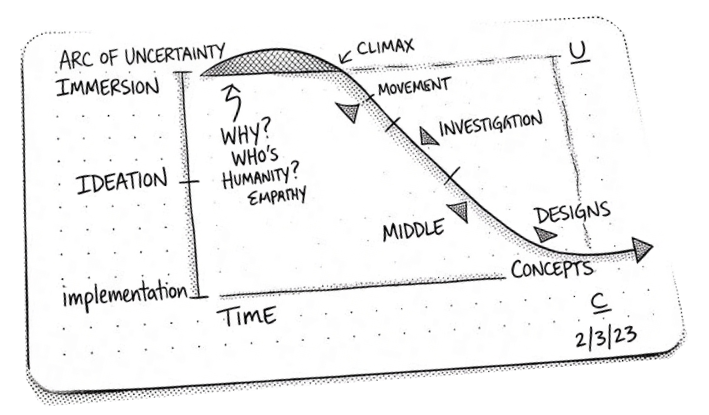
Shallow understanding is what happens when a team refuses to enter that arc. AI, dashboards, decks, and secondhand research all offer an exit ramp around the uncomfortable part — a way to arrive at an answer without ever sitting in the not-knowing long enough to find the real question. The tools aren’t the problem. Skipping the arc is the problem. The tools just make skipping it faster and easier to hide.
Meaningful decision-making requires walking the whole arc. You state what you actually know. You admit, out loud, what you don’t. You go find out — talk to the advisors, watch the workflow, ask the dumb question in the room instead of the smart one in the slide. And only then do you let the data, the model, or the AI tool help you move fast on a question you’ve actually earned the right to answer.
The firms and the teams that get this right aren’t the ones with the most sophisticated tooling. They’re the ones willing to stay uncomfortable a little longer than everyone else, because that’s where the gist is hiding.
Co-author of “Is AI Killing User Experience?” with Scott A. Snyder, Knowledge at Wharton, June 2026.