I guest lectured a class recently. As usual, the best part came after the talk, when a student sent this(her magic wand question):
“Wish you included one summary diagram that captures your entire AI stack. Some sort of table, with each tool listed that breaks down what you use it for, and where it fits in your workflow. I’ve only touched about a third of the tools you mentioned, so a master visual might help me understand how they all weave together. Tell me a story!” — A
Tell me a story. Fair enough. I’d spent an hour telling a room that a list of facts isn’t a story, and then I’d handed them a list of tools.
So here’s the diagram. Here’s the story too, because the diagram only makes sense with it.
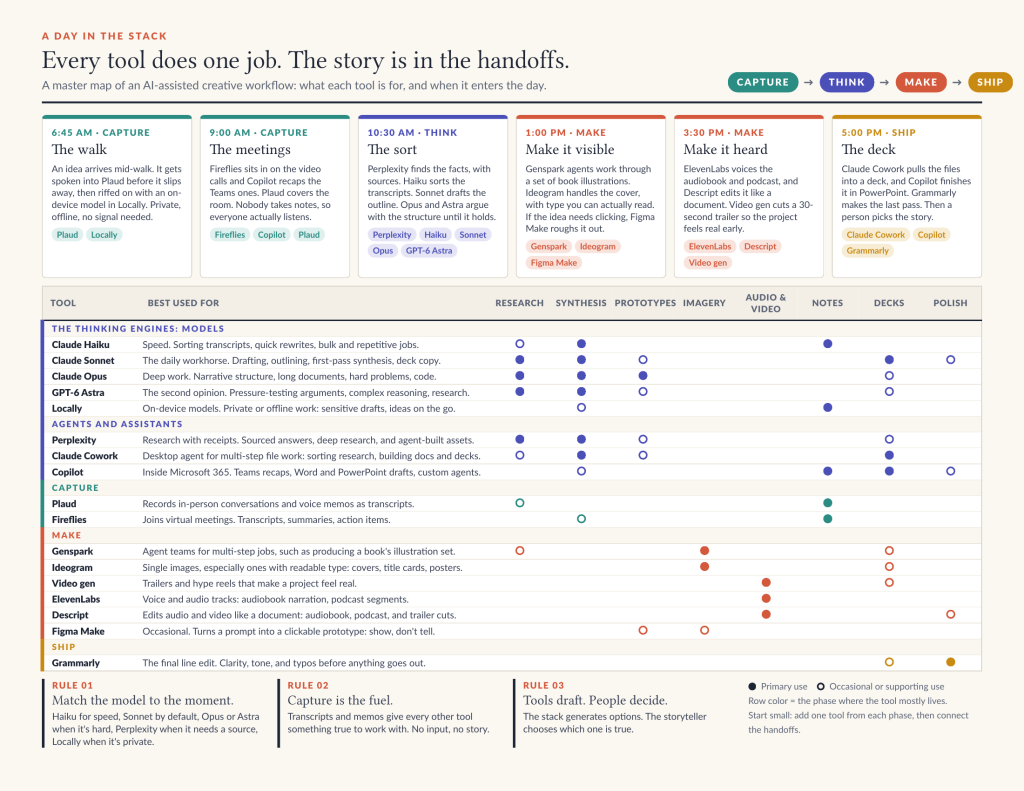
A Day in the Stack: a one-page map of an AI-assisted creative workflow, showing a six-moment day across Capture, Think, Make and Ship, plus a table of 17 tools and where each fits
A Day in the Stack: the day on top, the cast list below.
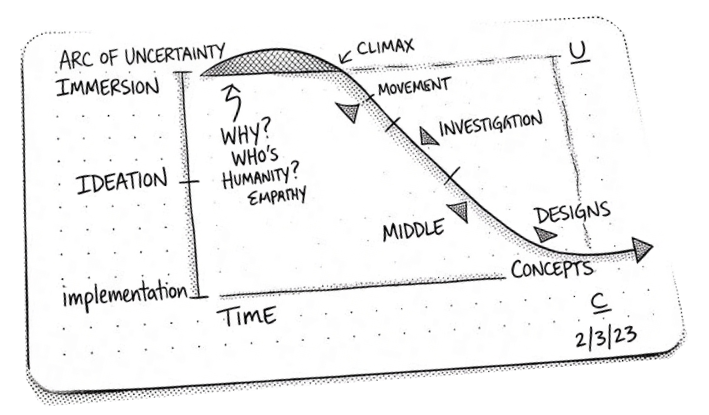
I wrote The Backstory on Storytelling on index cards, over five years. One idea per card, and none of them in order at first. The story came from moving the cards around until they made an arc.
My AI stack works the same way. Each tool is a card with one job on it. None of them tells the story alone. The story is in how you sequence them, and in the handoffs from one to the next.
That’s the headline on the diagram: Every tool does one job. The story is in the handoffs.
A day in four acts
The map follows one day, moving through four phases: Capture, Think, Make, Ship.
6:45 AM: The walk. Ideas show up when they want to, usually when I’m walking. I talk into Plaud before the idea gets away. If I want to push on it right there, I use an on-device model in Locally. It’s private, it works offline, and I don’t need a signal.
9:00 AM: The meetings. Fireflies sits in on video calls. Copilot recaps the Teams meetings. Plaud covers the conversation in the room. Nobody’s typing notes, so everyone is actually listening. I teach that listening is where a story starts. The tools just protect the time for it.
10:30 AM: The sort. This is where raw material starts turning into an argument. Perplexity finds the facts and shows the sources. Claude Haiku sorts the morning’s transcripts in seconds. Sonnet drafts the outline. Then I let Opus and GPT-6 Astra argue with the structure until it holds. I don’t want an echo. I want a sparring partner.
1:00 PM: Make it visible. Genspark’s agents work through a set of illustrations for the book. Ideogram does the cover art, because it handles type you can actually read. If an idea needs to be clicked rather than explained, Figma Make roughs out a prototype. Show, don’t tell.
3:30 PM: Make it heard. ElevenLabs voices tracks for the audiobook and the podcast. Descript lets me edit the audio like a document. A video generator cuts a 30-second trailer, so the project feels real before it’s finished. A hype reel is a story promising the audience something.
5:00 PM: The deck. Claude Cowork pulls the day’s files into a draft. Copilot finishes it in PowerPoint. Grammarly makes the last pass. Then a person decides what the story is. That person is me, and in your case it’s you.
The second half of the diagram is a table: every tool, what it’s best for, and where it fits in research, synthesis, prototypes, imagery, audio and video, notes, decks, and polish.
Think of it as the cast list. The day is the plot. A cast list tells you who’s in the show. It doesn’t tell you what happens. Students who’ve only tried a third of these tools don’t need all seventeen. They need to know which role is missing from their own cast.
Three rules I keep coming back to
1. Match the model to the moment. Haiku for speed. Sonnet by default. Opus or Astra when it’s hard. Perplexity when you need a source. Locally when it’s private. Using the biggest model for everything is like opening every presentation with your big finish. You burn the energy you’ll need later.
2. Capture is the fuel. In the book I talk about 3 Is More Than Magic: one example is an anecdote, two is a coincidence, three is a pattern. You can’t find three examples of anything if you didn’t capture the first two. Transcripts, voice memos and meeting notes are the index cards of this decade. They give every other tool something true to work with.
3. Tools draft. People decide. This one matters most. The stack produces options: outlines, images, voices, trailers, decks. It doesn’t know which one is true, which one your audience needs, or which one you’d put your name on. That’s still the storyteller’s job, and it’s why I teach The 5 Slide Rule. If you can’t get your argument down to five beats, no tool will find it for you. You’ll just get a longer version of the confusion.
Why this matters for storytellers
Every class brings the same fear to the surface, even when nobody says it out loud: if AI can write the draft, make the image and voice the narration, what’s left for me?
The handoffs. The sequence. The judgment about what goes on the next card and what gets cut. Structure, stakes, tension and payoff are still human work. The tools just made the rest of the job faster, and that leaves more time for the part that was always the job.
So here’s the homework I’d give that student and anyone else looking at the map: don’t adopt a stack. Build a day. Pick one tool from each phase, Capture, Think, Make and Ship. Run one real project through them. Notice where the handoffs break. That’s where your story is.
Thanks for the question. You were right: it needed a story.
Mike Welsh is a storyteller, creative director, and author of The Backstory on Storytelling. He works through Keepmoving Company and guest lectures on storytelling, design thinking, and executive communication. More at thebackstoryonstorytelling.com.